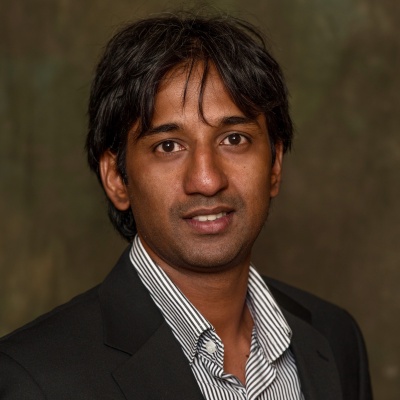
Vishnu Naresh Boddeti is an Associate Professor in the Department of Computer Science and Engineering at Michigan State University (MSU) and the Director of the Human Analysis Lab.
His research develops AI systems with provable guarantees of fairness, privacy, and accuracy. His work spans three interconnected areas: (1) auditing and mitigating bias in foundation models through optimal fairness-utility trade-offs and adversarial red-teaming, (2) cryptographically secure AI via homomorphic encryption, designing FHE-native architectures that scale to real-world deployment, and (3) physics-informed AI for scientific discovery, integrating physical laws to reduce data requirements and improve generalization. His work demonstrates that properly designed constraints (cryptographic, statistical, or physical) enable capabilities rather than limit AI models, providing the theoretical foundations and practical systems needed for trustworthy AI deployment in high-stakes domains.
Prospective Students
I am always looking for motivated students with strong mathematical backgrounds who are interested in computer vision and machine learning. If you are interested in working with me:
- PhD Applicants: Apply through the MSU CSE Graduate Program and mention my name in your application
- Current MSU Students: Feel free to reach out via email with your CV and research interests
- Visiting Students: I occasionally host visiting scholars; please contact me with your credentials and proposed research plan
Please review my publications and recent news to understand the research directions in the lab before contacting me.
News
- 11/30/2025 - Named Senior Area Editor for IEEE TIFS
- 06/12/2025 - Delivered Tutorial on Computer Vision over Homomorphically Encrypted Data at CVPR 2025
- 04/01/2025 - Named Area Chair for NeurIPS 2025
- 10/25/2024 - Published in Nature Communications with Editor Highlight: “Mechanics-informed autoencoder enables automated detection and localization of unforeseen structural damage”
- 07/01/2024 - Delivered Tutorial on Biometric Privacy and Security at IJCB 2024
- 09/15/2024 - Received 2024 IEEE-CCF Best Paper Award for “Towards Transmission-friendly and Robust CNN Models over Cloud and Device”
- 07/01/2024 - Delivered Tutorial on Multi-Objective Machine Learning at WCCI 2024
- 10/02/2023 - Best Paper Award Finalist at IROS 2023: “Discovering Adaptable Symbolic Algorithms from Scratch”
- 08/01/2023 - Best Student Paper Award (TBIOM 2022-2023): “HERS: Homomorphically Encrypted Representation Search”
- 07/27/2023 - “HADAR: Heat-Assisted Detection and Ranging” featured on Nature cover with video description available
- 06/19/2023 - Delivered Tutorial on Multi-Objective Optimization for Deep Learning at CVPR 2023
- 03/20/2023 - Accepted International Workshop on Federated Learning to KDD 2023
- 02/20/2023 - Named Area Chair at AutoML 2023
- 02/01/2023 - Bashir Sadeghi’s paper on invariant representation learning received Featured Certification at TMLR; later became finalist for outstanding certification
- 10/15/2022 - Luke Sperling’s “HEFT: Homomorphically Encrypted Fusion of Biometric Templates” won Best Student Paper Award at IJCB 2022
- 10/01/2022 - Xuyang Li’s structural systems boundary condition paper received Student Best Paper Award at SMASIS 2022
- 06/01/2022 - Named Web Chair for FG 2023
- 05/01/2022 - Named Area Chair at IJCB 2022
- 02/20/2022 - Named Area Chair at AutoML 2022
- 01/01/2021 - Received Facebook Research Grant on Multi-objective Co-evolutionary Learning
- 07/17/2019 - Zhichao Lu’s “NSGA-NET” won Best Paper Award (EML Track) at GECCO 2019
- 12/05/2018 - Rahul Dey’s “RankGAN” received Best Student Paper Award at ACCV 2018